




How Are DVC Resorts Incorporating Sustainability

The environment is the friend of Disney Vacation Club members everywhere. In fact, just yesterday my brother started randomly praising the beauty of Disney’s Vero Beach resort. I quickly countered with the shores of Disney’s Polynesian Village Resort, and then we spent 15 minutes talking about various beautiful nature objects in plain sight at a variety of DVC resorts.
As a supporter of nature, Disney has ramped up its environmentally-friendly practices in recent years. So, how are DVC resorts incorporating sustainability? You’ll notice it in several ways during your visit. Here are just a few.
Sustainability in Hotel Rooms
In case you didn’t know, Disney published a series of environmental goals it hopes to complete by 2030. Vital to those goals is a reduction in single-use plastics at the various parks and resorts. As part of these changes, Disney has eliminated some familiar sights in DVC hotel rooms.

The most noteworthy updates occur in the bathroom, where we can no longer take tiny bottles of H2O home with us. No, I’m not talking about water, but rather the line of personal care items. H2O shampoo, conditioner, and body wash remain an essential part of a DVC hotel stay. Disney made sure of that by purchasing these formulas when the company originally selling these products retired the brand.
DVC has made some changes, though. To reduce its plastic consumption, Disney chose not to manufacture H2O products in the adorable tiny bottles. Instead, you’ll find giant dispensers in your DVC hotel bathroom. That’s great for the environment, but I’ll miss the joy of unpacking those tiny bottles and keeping a part of my Disney trip with me for weeks afterward.
Impressively, Disney has found a way to use its excess plastic as well. The new Island Tower at the Polynesian features rugs that harbor a secret. Disney has constructed these beautiful pieces of flooring from recycled plastic bottles.
You’ll notice one more environmental change in your hotel room, albeit something you might not enjoy. Disney has switched to automated air conditioning systems where smart thermostats control the room temperature. While guests have substantial say over their room temperature, Disney has created upper and lower boundaries to prevent excess energy usage.
Sustainability Around the Resorts

You’ll notice sustainability in other parts of your resort as well. Some are overt, while others are subtle. Disney has changed its menu practices to offer menus with more sustainable seafood. All you’ll notice is the freshness and the flavor, but it’s an important practice. The change I’m confident you’re aware of is that plastic straws are no longer a thing at Disney. All the parks and resorts have replaced them with paper straws.
Also, the resorts themselves are becoming more efficient. Disney brags that the Island Tower uses 30 percent less energy than the average hotel facility. The company has cracked the math on energy efficient construction. Reflections: A Disney Lakeside Lodge will likely use similar practices to reduce its energy demand.
Then, we have the odd case of the Cabins at Disney’s Fort Wilderness Resort. Creating more energy-efficient cabins was one of the primary reasons Disney demolished the old cabins and built entirely new ones. While the company’s environmental goals have a timeline of 2030, Disney is building sustainable facilities that will last for decades to come.
Sustainability on Disney Campuses
I’m referencing Walt Disney World specifically since it has the most room for growth, but Disney is working on a problem at all its facilities around the world. The problem is energy consumption, which, as you might imagine, is a massive problem for any theme park, much less one of this scale.
Walt Disney World officials now rely heavily on solar power rather than conventional utilities. In 2019, a massive solar farm went online for the first time. This wasn’t the first facility, but it was the largest. The 50 megawatt solar farm includes half a million panels. By operating this facility, Disney has managed the equivalent of removing 10,000 vehicles from the road. This solar farm alone can theoretically power two theme parks at Walt Disney World.
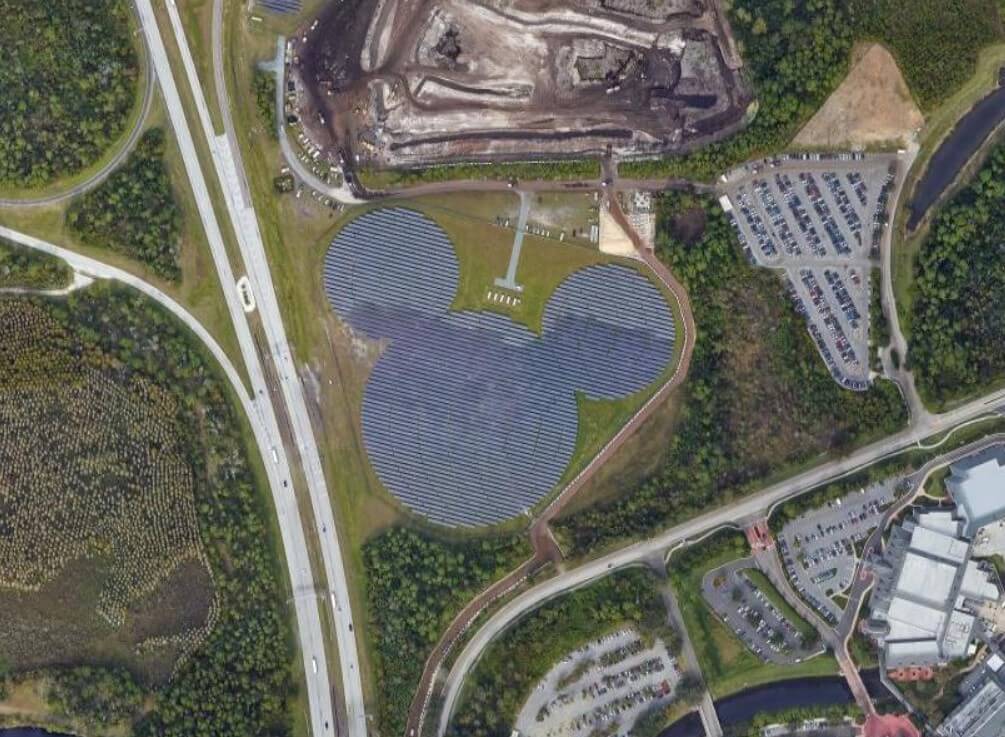
Courtesy of Google Maps
Disney built this solar farm in wake of successful operations of a 22-acre solar farm shaped like Mickey Mouse. Somehow, that’s not the only environmentally-friendly part of the endeavor. According to Disney, two-thirds of the facility is pollinator-friendly. So, most of the solar farm simultaneously doubles as a wildlife habitat for bees, butterflies, and the like.
Ultimately, Disney hopes to achieve zero net emissions by 2030. Their ambitious, environmentally-friendly plan highlights five pillars: emissions, materials, sustainable design, waste, and water. You can learn more about each one at this link, as I’ve barely even scratched the surface of Disney’s comprehensive sustainability practices.





Comments